
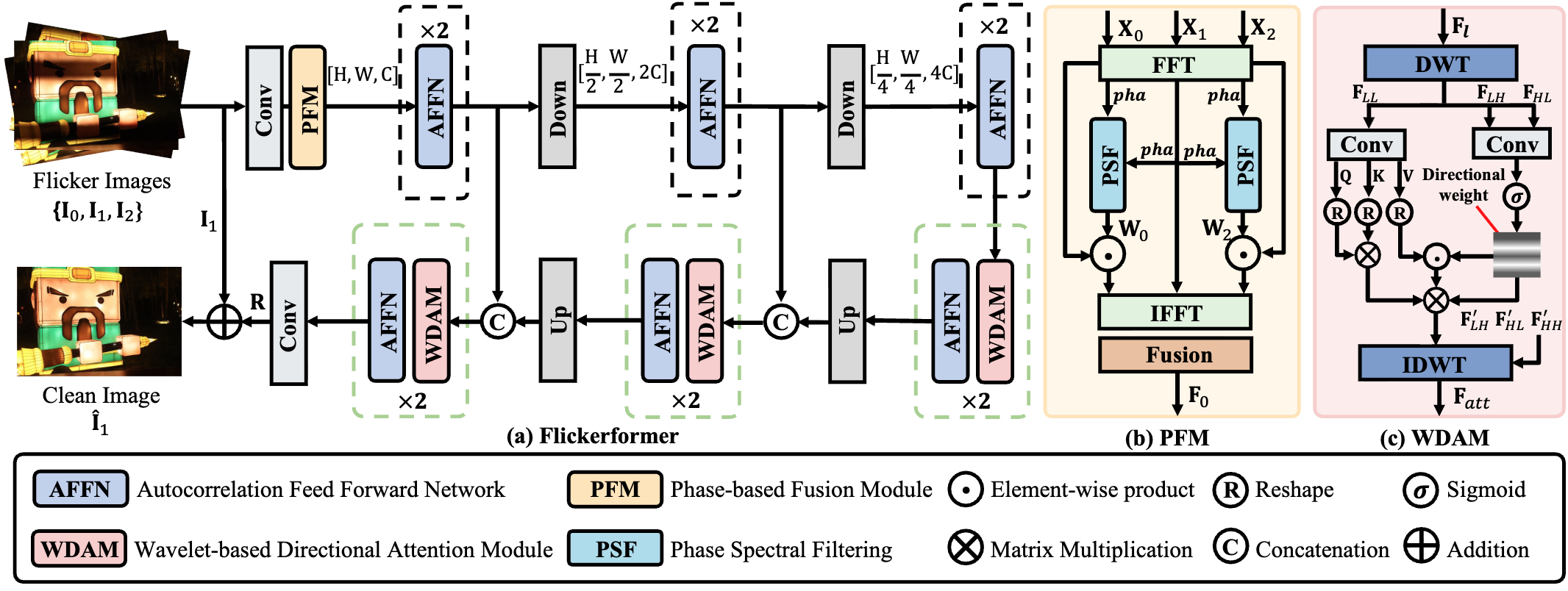
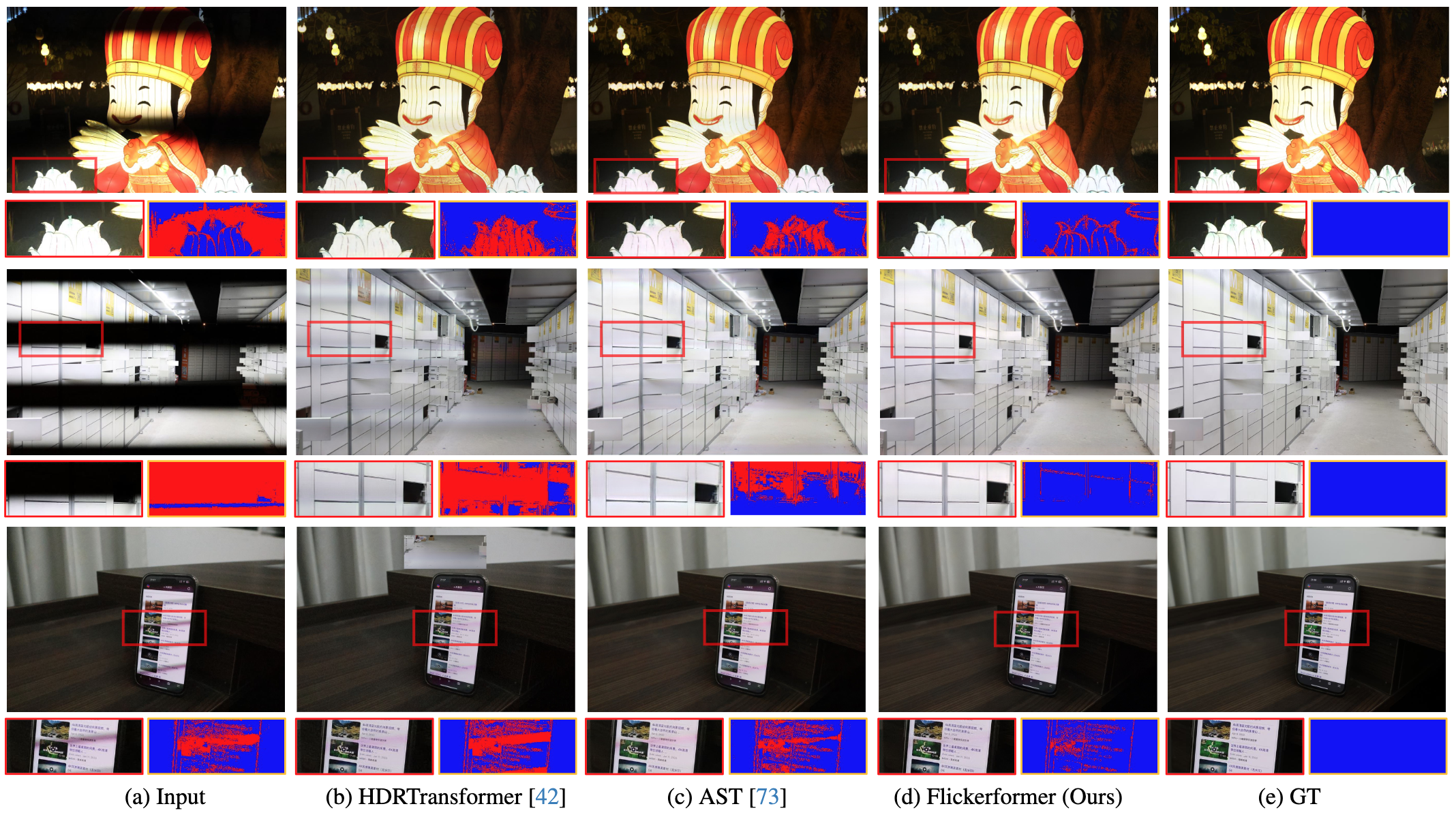
Flicker artifacts, arising from unstable illumination and row-wise exposure inconsistencies, pose a significant challenge in short-exposure photography, severely degrading image quality. Unlike typical artifacts, e.g., noise and low-light, flicker is a structured degradation with specific spatial-temporal patterns, which are not accounted for in current generic restoration frameworks, leading to suboptimal flicker suppression and ghosting artifacts. In this work, we reveal that flicker artifacts exhibit two intrinsic characteristics, periodicity and directionality, and propose Flickerformer, a transformer-based architecture that effectively removes flicker without introducing ghosting. Specifically, Flickerformer comprises three key components: a phase-based fusion module (PFM), an autocorrelation feed-forward network (AFFN), and a wavelet-based directional attention module (WDAM). Based on the periodicity, PFM performs inter-frame phase correlation to adaptively aggregate burst features, while AFFN exploits intra-frame structural regularities through autocorrelation, jointly enhancing the network’s ability to perceive spatially recurring patterns. Moreover, motivated by the directionality of flicker artifacts, WDAM leverages high-frequency variations in the wavelet domain to guide the restoration of low-frequency dark regions, yielding precise localization of flicker artifacts. Extensive experiments demonstrate that Flickerformer outperforms state-of-the-art approaches in both quantitative metrics and visual quality.
        @inproceedings{qu2026ittakestwo,
            title={It Takes Two: A Duet of Periodicity and Directionality for Burst Flicker Removal},
            author={Qu, Lishen and Zhou, Shihao and Liang, Jie and Zeng, Hui and Zhang, Lei and Yang, Jufeng},
            booktitle={Proceedings of the IEEE/CVF Conference on Computer Vision and Pattern Recognition},
            year={2026}
          }